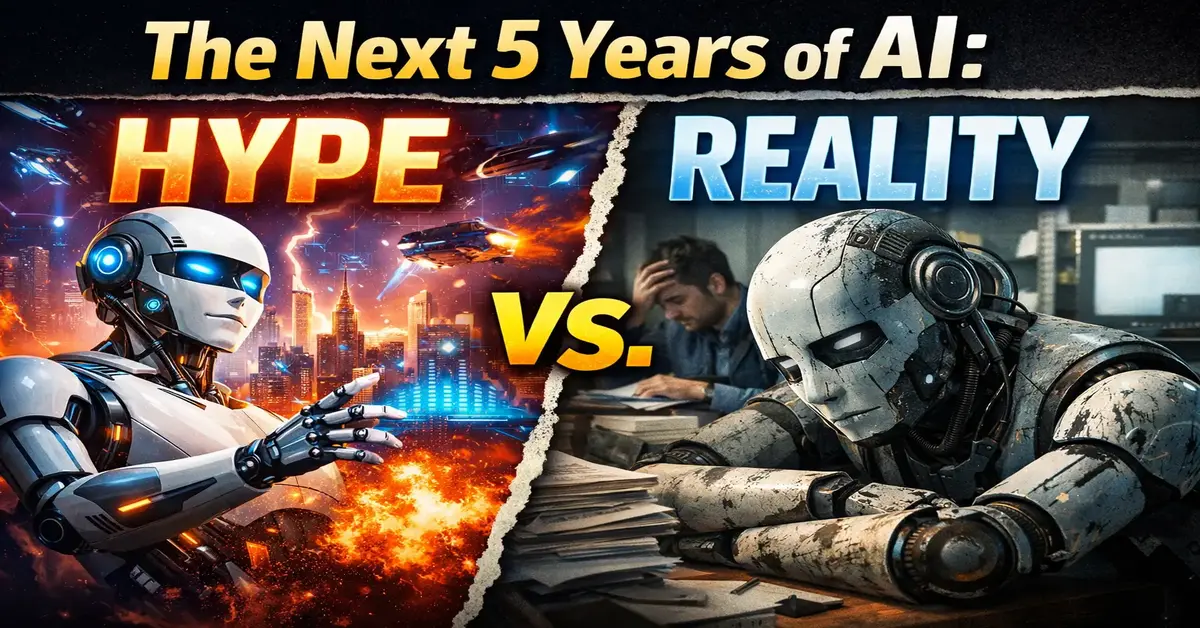
Let’s be honest—Artificial Intelligence isn’t just a “futuristic idea” anymore. It’s already here. It’s recommending your next Netflix show, helping doctors read X-rays, and probably even wrote the last email you received.
But if you think today’s AI is impressive, just wait. We are currently in the “dial-up internet” phase of AI. The next five years are going to take us from “AI as a tool” to “AI as a partner.”
Here is a realistic look at how this shift will actually impact your work, life, and sanity.
1. Why the Next 5 Years Are Make-or-Break
Every major tech shift has a tipping point—think of when smartphones first appeared. We are at that exact moment with AI. Right now, governments are scrambling to regulate it, companies are panic-hiring experts, and investors are pouring in billions. The decisions made in the next few years will decide if AI becomes a helpful assistant or a chaotic mess. It’s no longer about “if” you use AI, but “how” you survive without it.
2. Let’s Get Real: AI is Still Kind of Dumb
Despite the hype, today’s AI has limits. It’s fantastic at specific tasks—like crunching numbers or writing code—but it lacks common sense. It doesn’t “understand” things; it just predicts the next word in a sentence. Understanding this difference is key. Stop fearing a sci-fi robot takeover and start treating AI for what it is: a super-powered calculator that still needs a human pilot.
3. From “Hey Siri” to “I Know What You Need”
The biggest change coming? Context. Currently, you have to tell AI exactly what to do. In five years, AI will be proactive. Imagine an assistant that knows you’re stressed based on your calendar and automatically reschedules your low-priority meetings without you asking. The goal isn’t to impress you with tech; it’s to become invisible and just make things work.
4. Your Home Will Finally Be “Smart”
We’ve been promised smart homes for years, but usually, it’s just a fancy light switch. That’s about to change. Future AI won’t just wait for commands; it will manage your home’s energy, security, and temperature in the background. On a city level, imagine traffic lights that actually adjust to traffic flow in real-time. Less waiting, less energy waste.
5. The Elephant in the Room: Your Job
Will AI take jobs? Yes, the boring ones. History shows that automation kills tasks, not necessarily careers. If your job involves repetitive copy-pasting, you should be worried. But if your job involves empathy, complex strategy, or creative problem-solving, you are safe. The new rule: AI won’t replace you. A person using AI will replace you.
6. New Careers You Haven’t Heard of Yet
Just like “Social Media Manager” wasn’t a job 20 years ago, AI is creating new roles. We will need AI Ethicists, Prompt Engineers, and “Human-AI Collaborators.” The most valuable skill in 2030 won’t be coding—it will be adaptability. The ability to unlearn old methods and learn new ones quickly will be your biggest asset.
7. Healthcare Gets Personal
This is where things get exciting. Instead of the “one-size-fits-all” medicine we have now, AI will help doctors tailor treatments to your specific DNA and lifestyle. We are moving from fixing problems (reactive) to predicting them (preventive). Imagine catching a disease years before symptoms even show up.
8. Education: No More “Factory” Learning
Our current education system treats every student the same. AI will break that model. Imagine a classroom where every student has a personal AI tutor that adjusts to their learning speed. Teachers can stop being administrators and go back to being mentors. It’s about personalized growth, not standardized testing.
9. The Ethics Check (The Scary Stuff)
We can’t ignore the risks. Deepfakes, privacy breaches, and algorithmic bias are real problems. The next five years will see a massive push for “AI Seatbelts”—laws and regulations to keep things safe. AI safety is about to become as big an industry as Cyber Security.
Conclusion:
Don’t Just Watch, Participate The next five years aren’t just happening to us; we are shaping them. AI is a powerful engine, but we are still in the driver’s seat. The question isn’t “What will AI do?”—it’s “What will YOU do with AI?”